SNAP OUT OF IT! There’s hope!
The current Supplemental Nutrition Assistance Program (SNAP) was prototyped during the Great Depression in the midst of a world war. It became enacted into law with the Food Stamp Act in 1964 during the Civil Rights movement and during other foreign wars. In 2008, it officially became known as SNAP, and the use of food stamps advanced to a digital EBT card. Almost all places that sell groceries accept SNAP, including many farmer’s markets.
As an educator and youth organizer in Boston, it’s important for me to teach and share about SNAP’s long history of helping low-income families get groceries that they cannot afford. Working in a field that seeks to improve food access and food security for residents and community members, I must hold space to pass on stories and cultural memories of food, recipes, nourishments and the joy of eating. Many of these stories are made possible because of SNAP, and now the long-standing program is being attacked more than ever.
Growing up in an immigrant household, being poor was always a stigma and having government assistance was a shame, especially for those of us coming from a country where relying on the government was dangerous. I see this shame in the young people I work with, but as I share the history and legacy of activists, organizers, land workers, farmers, and food service who fought for better working conditions, wages, and community health, we start to break down this wall of scarcity and competition with the realization that EVERYONE deserves to eat.
Below is some more information about the current environment and what we can do about it, provided by the Boston Food Access Council. On Wednesday, October 7th, 2026, I will be in front of the State House for the People’s Potluck to share food, listen to stories and songs about food, uplift other voices, and stand in solidarity with folks who believe in healthy food access for all. I hope to see you there, or at future gatherings!
What SNAP is
SNAP (Supplemental Nutrition Assistance Program) is a federal food assistance program where money is loaded onto an EBT card each month to buy groceries.
SNAP allows beneficiaries the flexibility to purchase foods independently while also providing the funds used to purchase food (EBT dollars) directly to grocers/farmers/producers.
Why it matters
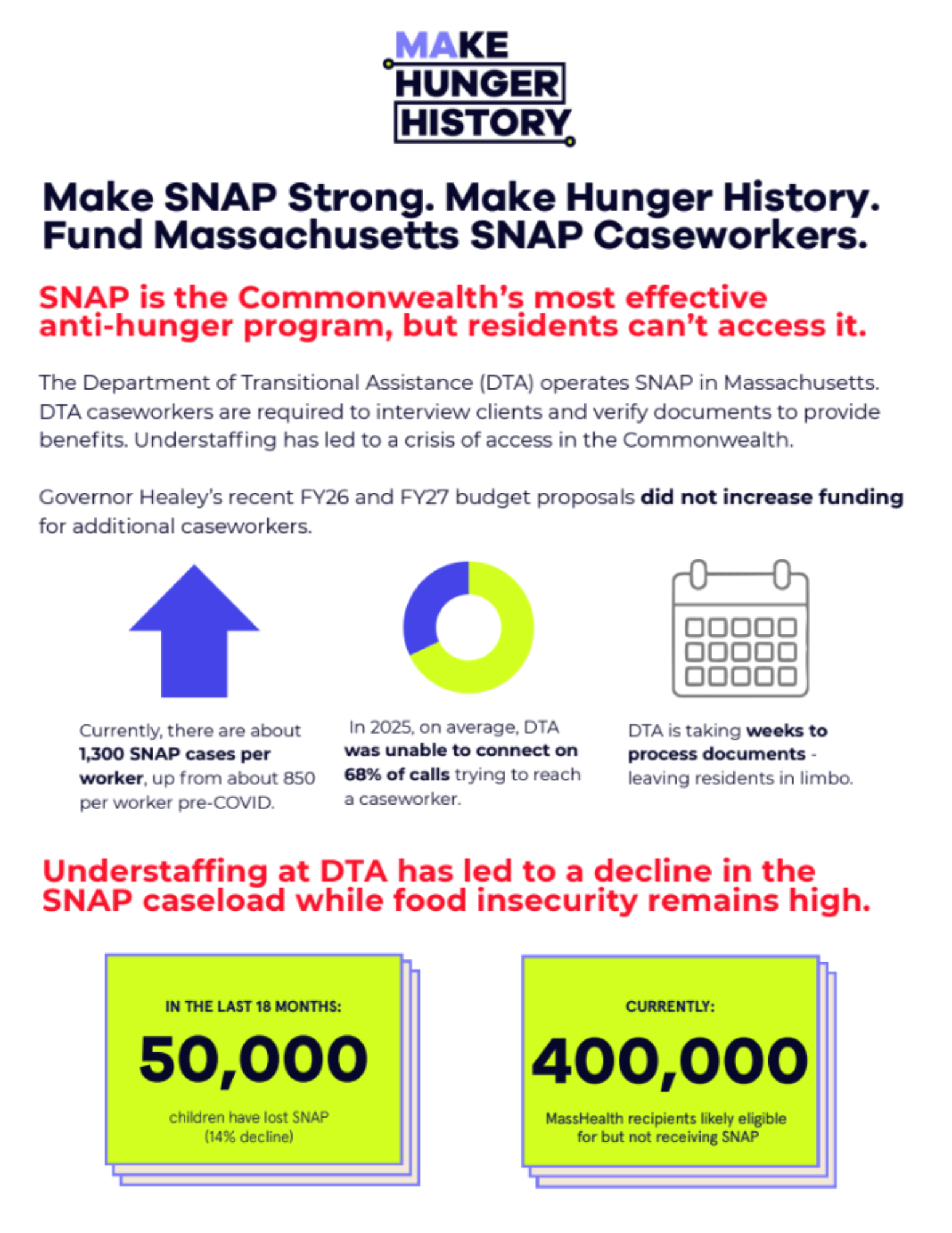
Nearly 1 million Massachusetts residents rely on SNAP: 31% are children, 31% are people with severe disabilities, and 26% are older adults.
Roughly 1 in every 5 grocery dollars spent in Massachusetts is a SNAP dollar, so this isn't just about families; it supports local grocers and farmers too.
40% of Massachusetts households struggled to afford enough food last year which is more than double the rate in 2019.
What's under threat
A 2025 federal law (the “One Big Beautiful Bill,” or OB3) added new paperwork and work-requirement rules, and, for the first time, it makes states pay part of the cost when SNAP error rates run high.
Because Massachusetts hasn't staffed up its state SNAP office to handle that added workload, people are losing SNAP not because they're ineligible, but because they can't get a callback to finish required paperwork. This impacts both new and current beneficiaries.
New applicants are unable to get direct assistance with DTA when applying, which we all know is a paperwork nightmare
Current beneficiaries are required to 'renew' their applications every 6 - 12 months which may also require support or contact with DTA. If you cannot renew your paperwork, your benefits are cut off. Often they will back-pay missed benefits if you complete the renewal process quickly enough; otherwise you start over from the beginning.
About 200,000 Massachusetts residents lost SNAP in the past year, including 50,000 children, nearly 12,000 of our neighbors right here in Boston.
Two levels of government, one program
DTA (Department of Transitional Assistance) is the Massachusetts state agency that runs SNAP day to day operations.
The federal government (through USDA) funds the actual benefit dollars people receive.
The state government (the Governor and Legislature) funds and staffs the DTA caseworkers who process applications and answer calls.
What DTA caseworkers actually do
Conduct required interviews for new applications and yearly "recertifications," process paperwork changes (new job, address, income), and decide who stays eligible.
By federal rule, this work must be done by trained, merit-based state employees. It legally cannot be handed off to nonprofits, private contractors, or AI tools.
The bottleneck
In spring 2026, DTA received about 20,000 calls a day, handled by only about 645 caseworkers.
To put this into perspective, if each caseworker solely took calls 8 hours a day, they could only allocate 15 minutes per person. We know that it takes much more time to answer the needs and questions of SNAP recipients and handle the admin work.
Through 2025 and into 2026, DTA was blocking or disconnecting 68–80% of calls before anyone could pick up.
New federal eligibility rules also made interviews longer and more complex, requiring up to an hour per person, twice as long as before. The same number of staff are now helping even fewer people.
Who controls DTA's staffing — and where things stand right now
The Massachusetts Governor and State Legislature set DTA's staffing budget every year through the state budget. That's a state decision which is why this campaign targets Governor Healey and state lawmakers, not Congress.
The FY27 state budget was signed in July 2026 with $122 million for DTA caseworkers — about $21 million less than the $147.7 million advocates (and even the Governor's own earlier budget proposal) had called for.
Analysts estimate that gap could mean roughly 150 fewer caseworkers - the opposite of the 200 additional workers this campaign is fighting for. Advocates are now pushing for a supplemental budget later this year to close the gap.
How to Get Involved!
Host a teach-in — like this one! Bring this conversation to your own community: a pantry, farmers market, faith community, or block party. (Grows our base)
Meet with your legislators — join neighbors in a meeting with your state rep or senator about fully funding DTA. Guidance is hyperlinked (Builds political power)
Talk with your local grocer — many EBT-accepting stores are affected too. Invite them to sign a grocers' letter to the Governor. (Brings new allies)
Tu Anh Phan participated in the Farmer Training Program in 2017 and is now on the education team at UFI. Tu comes from a Vietnamese immigrant background and has proud roots in Dorchester. Tu has 15+ years of experience in youth development and community organizing in Boston. Tu became involved in food justice work when Tu went to an organizing training in Oakland and witnessed the importance of culturally relevant food and relationship to land in community development. Tu's recent projects include growing tulsi, birding at any chance, and running forum theatre workshops.